Tree Trimming and Pruning in Northern Virginia
Most pruning done on Northern Virginia properties is done at the wrong time, in the wrong amount, or for the wrong reason. The short version: prune in the dormant season for most species, take dead wood out any time of year, keep live-wood removal on a mature tree well under the 25 percent ceiling the industry standard allows, cut just outside the branch collar rather than flush to the trunk, and never top a tree. Everything below is the reasoning behind those four sentences, and the local details — utility easements, right-of-way boundaries, oak timing — that decide how they apply on a specific lot in Fairfax County.
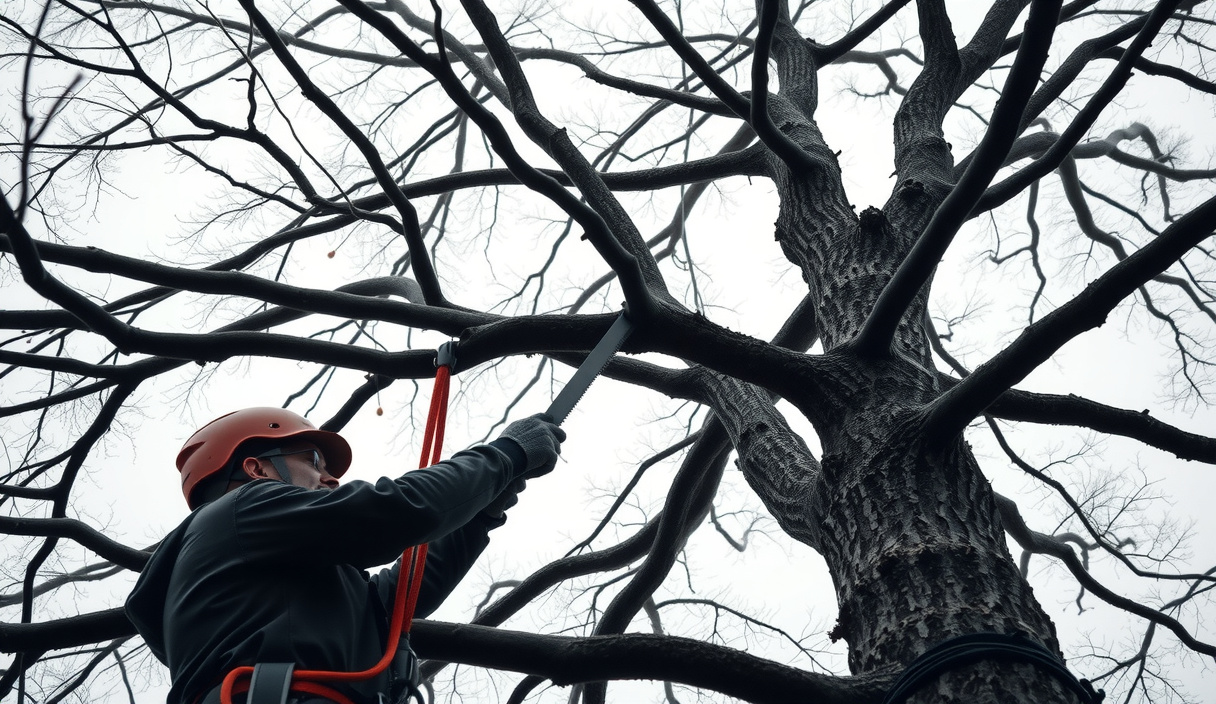
Pruning is a set of objectives, not a service
The word “trimming” hides an important distinction. Cutting a branch is a technique. Why you are cutting it is an objective, and the objective determines which branches come off and how many.
The American National Standard for tree care operations, ANSI A300 Part 1, is the document the trade writes specifications against. It frames every pruning job as one or more stated objectives — manage risk, manage health, develop structure, provide clearance, manage size or shape, improve aesthetics, manage fruit or flower production, manage wildlife habitat — and then defines the systems used to reach them. A crew that cannot tell you which of those it is working toward is not working to a specification. It is just removing wood.
The systems themselves are worth knowing by name, because they are what belongs on a written estimate:
| System | What is removed | Typical reason on a suburban lot |
|---|---|---|
| Cleaning | Dead, diseased, broken and detached branches | Baseline maintenance; the lowest-risk pruning there is |
| Thinning | Selected live branches, to reduce density | Rarely justified on a healthy mature tree; heavily overused |
| Raising | Lower branches, to create vertical clearance | Sidewalk, driveway, mower and roofline clearance |
| Reduction | Length of limbs, cut back to a live lateral large enough to assume the terminal role | Reducing end weight on an over-extended limb; clearing a structure |
| Restoration | Selected sprouts after topping, storm damage or vandalism | Rebuilding structure on a tree that was already damaged |
Cleaning and raising cover the large majority of what a residential tree in Springfield or Burke actually needs. Reduction is the specialist’s tool and the one most often confused with topping. Thinning is the one to be most skeptical of when it appears on an estimate for a tree that is not showing a problem.
The Northern Virginia pruning calendar
Timing is where local specificity matters, and where the Virginia Cooperative Extension pruning calendar is the reference worth keeping. Northern Virginia sits mostly in USDA zone 7a to 7b, at the warmer end of the range the calendar covers, which pulls the dormant window a little earlier than in the western part of the state.
Dead wood comes out any time. There is no seasonal restriction on removing branches that are already dead, and waiting on obviously hazardous dead wood over a driveway to reach February is the wrong trade-off.
Live pruning is a dormant-season job for most species. Late winter — roughly February into early March here — is the default. The tree is leafless, so structure is visible; wound closure begins quickly once growth resumes; and most of the insects and pathogens that exploit fresh wounds are not active.
| Group | Best window locally | Why |
|---|---|---|
| Oaks (white, red, willow, pin) | Late fall through midwinter | Beetles that move oak wilt are active on fresh wounds in the growing season; the conservative window is November to February |
| Maples, birches, walnuts, elms | Late winter, or midsummer after leaf-out | These “bleed” sap heavily in late winter — cosmetic, not harmful, but midsummer avoids it |
| Spring-flowering ornamentals (dogwood, redbud, cherry, crabapple, magnolia) | Immediately after bloom | Flower buds for next spring set on old wood; late-summer pruning removes the display |
| Crape myrtle | Late winter, before bud break | Also the point at which the annual temptation to top it should be resisted |
| Most shade trees with no flowering concern | Late winter | Structure is visible and the growing season follows immediately |
The one window to avoid across the board is early autumn. Pruning in September and October pushes late flushes of growth that do not harden off before the first hard freeze, and wound response slows as the tree moves into dormancy.
Oaks deserve their own note in this region. Oak wilt is a vascular disease spread in part by sap-feeding beetles drawn to fresh wounds during the growing season, and red-oak-group species can decline very quickly once infected. Northern Virginia’s oaks are already carrying stress from drought cycles and, on many lots, from bacterial leaf scorch. The cost of confining oak pruning to the cold months is essentially zero, so there is no good reason to take the risk. If storm damage forces an emergency cut on an oak in June, the cut gets made — safety first — and it is one of the very few situations in which a thin coat of wound dressing over the cut is defensible.
How much can safely come off
This is the question homeowners almost never ask and the one that separates competent work from expensive damage.
Leaves are how a tree pays for everything else: root growth, defense chemistry, wound response, stored reserves. Every live branch removed is a permanent withdrawal from that account. ANSI A300 sets an outer limit of 25 percent of live foliage removed from a mature tree in a single operation, but the University of Florida’s preventive pruning guidance makes the more useful point: that ceiling is far too much in most circumstances. Ten percent or less is the sensible working figure for a healthy mature tree, and a tree already under stress — recently transplanted, root-severed by construction, in decline — should have no live foliage removed at all beyond what safety requires.
Young trees are the exception. A tree under about twenty feet can tolerate and benefit from considerably more, because the point of pruning it is to build a structure that will not need expensive intervention in thirty years.
Two specific practices to recognize and refuse:
Lion’s tailing strips the interior lateral branches out of a limb and leaves foliage bunched at the ends. It looks tidy from the ground. It moves weight to the limb tip, removes the interior growth that tapers and strengthens the limb, and exposes previously shaded bark to direct sun. Storm-damage failures on suburban hardwoods frequently trace back to it.
Over-raising removes so much of the lower crown that the tree ends up as a tall pole with a tuft on top. Beyond the foliage loss, it removes the lower branches that build trunk taper — the very thing that lets a trunk resist bending loads.
The cut itself
Where a cut lands matters more than what tool made it.
Every branch meets its parent stem at a branch collar — the slight swelling at the base — with a raised branch bark ridge in the crotch above it. That collar contains the chemically and physically distinct tissue a tree uses to wall off the wound. Cut outside the collar and the tree closes over the wound from all sides. Cut flush to the trunk, removing the collar, and you have opened a wound the tree is structurally unable to seal quickly; decay moves into the trunk instead of staying in the branch stub.
The opposite error is a stub cut, leaving several inches of branch beyond the collar. The stub has no living tissue to close the wound, so it dies back and rots inward.
Any branch heavy enough to tear uses the three-cut method:
- An undercut on the underside of the branch, roughly a foot out from the collar, about a third of the way through.
- A top cut an inch or two further out, which lets the branch fall free — the undercut stops the bark from stripping down the trunk.
- A final cut removing the remaining stub, angled just outside the branch collar.
Two persistent myths worth retiring. Wound paint and pruning sealers do not help; they trap moisture and slow closure, and the only defensible exception is the oak-in-growing-season case above. And “cleaning up” a wound by cutting it back to fresh tissue does more harm than good — the tree’s compartmentalization response is already underway.
Young trees are where the money is
The single highest-return tree work on a Northern Virginia property costs a few hundred dollars and happens on trees nobody is worried about yet.
Most of the failures that produce five-figure removal invoices on mature trees are structural defects that were visible and correctable when the tree was ten feet tall. The most common is the codominant stem: two roughly equal leaders competing for the top, with included bark — bark pinched between them rather than wood grown together — forming a seam that is a crack waiting to open. On a mature tulip poplar or silver maple over a roofline, that seam is the failure point.
Correcting it on a young tree is not a removal. It is a subordination cut: shortening the weaker of the two leaders back to a lateral so the stronger one takes over, repeated over a few visits across several years. On a tree with a six-inch trunk it takes minutes. On a tree with a thirty-inch trunk it is no longer possible; the options are cabling, reduction, or eventually removal.
A young-tree program looks like this:
- Years 1–3 after planting: remove only dead, broken and rubbing branches. Leave the low temporary branches alone — they are building trunk taper.
- Years 3–8: establish a single dominant leader. Subordinate competitors. Begin removing the lowest temporary branches gradually.
- Years 8–15: set permanent scaffold branches with adequate vertical spacing, raise the crown to its final clearance height, and space limbs so no two originate at nearly the same point.
- Thereafter: a cleaning pass every three to five years is usually the whole maintenance requirement.
Compare that to the alternative, which is a phone call in year forty about a limb over the bedroom. The related decisions about when a tree has passed the point where pruning helps are covered in the guide to tree removal, costs and permits in Springfield.
Topping, and why it keeps happening
Topping is the reduction of a tree’s size by cutting limbs back to stubs at a predetermined height, without regard to where a suitable lateral branch is. ANSI A300 names it as an unacceptable practice. It persists anyway, for three reasons that all sound reasonable to a homeowner: fear of storm damage, a desire for a view or more light, and — with crape myrtles — the belief that it produces more flowers.
What actually happens is the reverse of what is wanted. The tree responds to the sudden loss of foliage by pushing dense epicormic sprouts from dormant buds below the cuts. Those sprouts grow fast, and they attach only to the outer layers of the stub rather than being anchored in the wood. Within a few years the tree is taller than it was, denser than it was, and carrying a crown of weakly attached limbs on top of a set of rotting stubs. The storm risk that motivated the topping is now materially higher, and the only remedies are years of restoration pruning or removal.
Crape myrtles are the local epidemic. They are everywhere in Springfield, Burke and Annandale, and every February a great many of them are cut back to the same knuckled stubs. Crape myrtles bloom on new wood, so the practice does produce flowers — which is why it survives — but on long whippy shoots that bend under the weight of wet blooms, from a permanently disfigured framework. The correct approach is to select three to five strong trunks, remove the rest at ground level, gradually raise the lower branches, take out crossing and inward growth, and otherwise leave the thing alone. A crape myrtle pruned this way for ten years is a small tree. One topped for ten years is a coat rack.
If a tree genuinely is too large for its space, that is not a pruning problem. It is a species-selection problem, and the honest answer is removal and replacement with something appropriately sized, not an annual mutilation contract.
Power lines, right-of-way and property lines
Northern Virginia’s suburban lots put a lot of large trees near infrastructure owned by somebody else, and the responsibility split is not intuitive.
Overhead lines. Virginia’s Overhead High Voltage Line Safety Act (Va. Code § 59.1-408) prohibits work that places a person, tool, ladder or piece of equipment within ten feet of an overhead high voltage line without first arranging safety measures with the line’s owner or operator. Ten feet is not a guideline; it is a statutory distance, and it is why a homeowner with a pole saw is a genuine emergency risk rather than a minor one. Dominion Energy’s Virginia tree trimming guidance sets out the rest: the utility maintains clearance around distribution lines on a roughly four-year cycle, working to A300 standards, and for the service line running to an individual house it will de-energize the line at no cost so the owner’s contractor can work safely — but it will not do that work itself.
Right-of-way trees. Whether the tree between the sidewalk and the street is yours depends on who maintains the road. In Fairfax County most residential streets are in VDOT’s system, not the county’s, and the county publishes a contact list for sorting out which agency owns a given tree. Trees fully on private property are the owner’s responsibility in every respect, and the county has no maintenance role.
Neighbors’ trees. The commonly understood position in Virginia is that a property owner may prune branches encroaching over the boundary line, at their own expense and back to the line, without damaging the tree’s health — and that damaging or killing a neighbor’s tree creates liability. The details of any specific dispute are a question for a Virginia attorney, not a tree crew, and any contractor who volunteers a confident legal opinion about your neighbor’s oak should be treated with caution.
HOA and common-area trees. Many Springfield-area subdivisions hold significant tree canopy in common areas under association ownership. Those trees are the association’s responsibility and its budget line, and a resident arranging private pruning on them is usually creating a problem rather than solving one.
Specifying the work and choosing the crew
A written estimate that says “trim trees — $1,800” is not a specification. It commits the contractor to nothing and gives you no basis for judging what you received. What belongs on the page:
- Which trees, identified individually by species and location
- The objective for each — clean, raise, reduce, restore — in those words
- For raising: the clearance height, in feet, over what surface
- For reduction: how much length, and the statement that cuts will be made back to live laterals
- A cap on live foliage removal
- Explicit exclusion of topping and lion’s tailing
- Who removes debris, and whether chips stay on site
- Proof of liability and workers’ compensation insurance, verified directly with the insurer
On credentials: ISA Certified Arborist is an individual credential earned by examination and maintained with continuing education; TCIA Accreditation is a company-level audit of business and safety practice. Neither is a licence and neither is legally required to cut a tree in Virginia, which is exactly why they are useful signals. Ask which specific person holding the certification will be on your property, not merely whether the company employs someone who has it.
Two warning signs worth acting on. Door-to-door solicitation after a storm, with pressure to sign immediately and pay a deposit in cash, is the classic pattern for storm-chasing operations that leave the region before the complaints arrive. And a crew that proposes topping, or uses climbing spikes on a tree that is being pruned rather than removed, is telling you what standard it works to. Spikes puncture the cambium at every step; on a tree meant to survive the visit they are indefensible.
For the broader context on soils, species and the seasonal calendar these decisions sit inside, see the complete guide to tree care in Springfield, Virginia.
Common questions
When is the best time to trim trees in Northern Virginia?
Late winter — February into early March — is the default for most species, because the tree is dormant, its structure is visible without leaves, and the growing season follows immediately to close the wounds. Dead wood can be removed at any time of year. Oaks are the main exception: keep pruning to the November-through-February window to avoid the growing-season beetle activity associated with oak wilt. Spring-flowering ornamentals like dogwood and redbud are pruned right after they bloom, so that next year’s flower buds are not removed.
How much of a tree can be pruned at one time?
The ANSI A300 standard sets an upper limit of 25 percent of live foliage on a mature tree in a single operation, but that is a ceiling, not a target. Ten percent or less is a more realistic figure for a healthy mature tree, and a tree that is already stressed by drought, construction damage or disease should have no live wood removed beyond what safety requires. Young trees being trained for structure can tolerate proportionally more.
Is topping ever acceptable?
No. ANSI A300 lists topping as an unacceptable practice. Cutting limbs back to stubs at an arbitrary height triggers dense, weakly attached sprout growth from below the cuts, leaves large wounds the tree cannot seal, and produces a tree that is more likely to fail in a storm within a few years, not less. If a tree is genuinely too large for its location, the honest options are a properly executed crown reduction by a qualified arborist, or removal and replacement with a smaller species.
Should pruning cuts be painted or sealed?
No. Wound dressings and pruning paints do not speed closure and can trap moisture against the wound, slowing the tree’s own compartmentalization response. A correctly placed cut just outside the branch collar is left alone. The narrow exception is an oak that has to be cut during the growing season because of storm damage, where a thin coating over the fresh wound is used to reduce its attractiveness to sap-feeding beetles.
Who is responsible for trimming trees near power lines?
The utility maintains clearance around its distribution lines on a routine cycle. The service line running from the pole to an individual house is different: Dominion Energy will de-energize that line at no charge so a homeowner’s contractor can work, but will not do the trimming. No property owner should attempt either — Virginia’s Overhead High Voltage Line Safety Act prohibits bringing a person, tool or ladder within ten feet of an overhead high voltage line without first arranging safety measures with the line’s owner.
How often do mature trees need pruning?
A structurally sound mature hardwood that was trained properly when young typically needs a cleaning pass — removing dead, broken and diseased wood — every three to five years. Trees over structures, over driveways, or showing defects warrant inspection more frequently, but inspection is not the same as cutting. Annual pruning of a healthy mature tree is almost always more than the tree needs and is a cumulative drain on its reserves.
Does pruning help a tree that is already declining?
Not usually, and it can accelerate the decline. A tree losing vigor needs its remaining foliage to rebuild reserves, so removing live wood makes the deficit worse. The appropriate response is to remove dead and hazardous wood only, and to diagnose the underlying cause — root damage, girdling roots, soil compaction, drought, disease — before deciding anything else. Pruning is not a treatment for a root problem.
Sources and standards referenced
- Virginia Cooperative Extension, A Guide to Successful Pruning: Deciduous Tree Pruning Calendar, publication 430-460 — pubs.ext.vt.edu
- ANSI A300 (Part 1), Tree, Shrub, and Other Woody Plant Management — Standard Practices (Pruning)
- Code of Virginia, Overhead High Voltage Line Safety Act, § 59.1-400 et seq.