Complete Guide to Tree Care in Springfield, Virginia
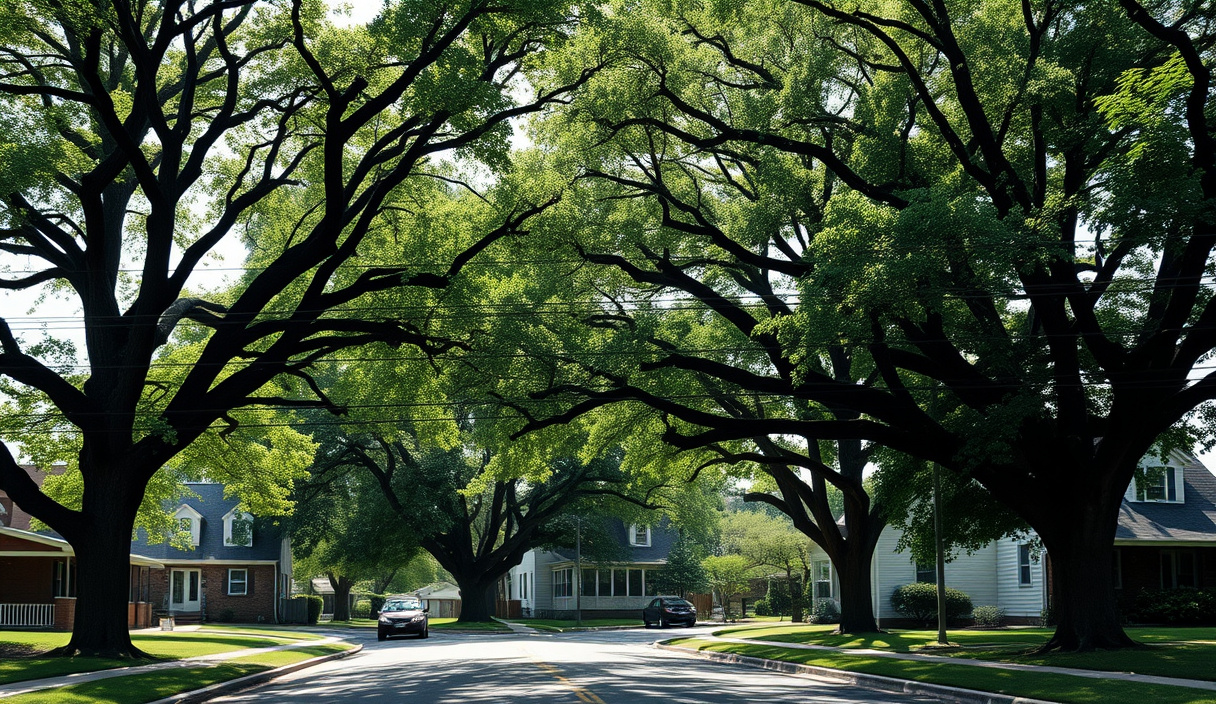
Springfield’s tree cover is mostly a product of when the place was built. The subdivisions filling the ground between Backlick Road, Old Keene Mill Road and Rolling Road went up through the 1950s and 60s, and the shade trees planted alongside those houses are now sixty and seventy years old. That is a particular stage in a tree’s life. It is past the point where anything you do counts as establishment, and into the stretch where structural defects that took decades to form start to matter — and where the cost of ignoring one climbs quickly.
Most homeowner guidance about trees is written for nowhere in particular. This is written for here, because the two things that most shape tree work in Springfield are local: what is under the ground, and what Fairfax County will and will not make you do about it.
The soil is not an afterthought
Parts of southeastern Fairfax County sit on marine clay, a deposit the county’s soil maps label Marumsco. It contains montmorillonite, a mineral that changes volume with moisture — the county’s homeowner’s guide to marine clay soils puts it plainly: the clays “shrink during dry periods of the year and swell during wet periods.” The band the county describes runs mainly through areas east of Interstates 95 and 395, which is to say it runs directly through the Springfield area.
For trees this matters in two directions.
Going down, roots in these soils reach further than most people assume. The county has observed tree roots “as deep as 15 feet in the Marine Clays,” extending well underneath a house and its foundation. Because a large tree pulls enormous volumes of water out of the ground in summer, it can dry the clay beneath a slab unevenly and contribute to the shrink-swell cycle the foundation is already fighting. The county’s own recommendation is to plant trees at least 20 feet from residential structures.
Going sideways, marine clay drains slowly and fails on slopes. A mature tree on a wet clay slope after a long soaking rain is a different risk than the same tree on well-drained ground. If your lot backs onto a steep grade east of the interstates, that is worth knowing before you assume a leaning trunk is cosmetic.
Not every Springfield property sits on this material. Fairfax County publishes soil maps and unit descriptions through Land Development Services, and it is worth ten minutes to find out which ground you are actually on before making decisions about planting distances or reading a lean.
What is actually growing here
The dominant canopy across Fairfax County yards is oak, tulip poplar, maple and hickory, with dogwood, redbud and holly filling the understory. Tulip poplars in particular are worth knowing by sight if you own one: they grow fast, grow tall, and shed limbs from height in summer storms. A tulip poplar overhanging a roof is a different maintenance proposition than an oak of the same age.
The practical point is that a sixty-year-old canopy tree is not a shrub that got big. It has a structure, and that structure has a history — old topping cuts, included bark in a codominant fork, a cavity where a limb tore out in a storm two decades ago. Most of what goes wrong with mature trees in Springfield is not sudden. It is a defect that was visible for years to someone who knew what to look at.
Whose problem is it
This is where people are most often wrong, and being wrong is expensive.
Fairfax County states it “has no legal authority to require the removal of hazardous tree(s) that are located on private property unless the tree(s) threaten the public at large.” The responsibility for a tree generally lies with the people or agency that owns or maintains the property. If your neighbour’s dying oak leans over your garage, the county is not going to make them deal with it. That is a civil matter between the two of you.
The exception is genuine public exposure. If a hazardous tree threatens public streets or sidewalks, a complaint can be filed through the county’s PLUS system; Forest Conservation staff will assess the risk, and where a public hazard is confirmed the county will issue a health and safety code enforcement violation and require the property owner to remove the tree. Threatening a neighbour’s property is not the same thing as threatening the public, and the county draws that line firmly.
The flip side is that the tree in your own yard is yours, including what it does when it fails. Documentation matters here. A dated written assessment from a qualified arborist, made before a failure rather than after, is the difference between an act of nature and a known hazard you left standing.
When you need permission to cut
For most Springfield homeowners removing an individual tree from their own yard, Virginia law does not require a permit. But there are four exceptions that catch people out, set out on the county’s tree removal page:
- Land disturbance over 2,500 square feet. Clearing at that scale needs approval. The county’s Engineer of the Day (703-324-2268) will tell you whether a given project crosses the line.
- Resource Protection Areas. In an RPA — the protective buffers around streams and wetlands — removal of trees or any vegetation is prohibited without a waiver. Much of the ground near Accotink Creek and its tributaries falls into this category.
- Conservation easements recorded against the property.
- HOA covenants, which are private agreements and entirely separate from county rules. Plenty of Springfield associations restrict removal regardless of what the county permits.
Land Development Services (703-222-0801) handles RPA and easement questions.
A note on sequence: confirm the RPA and easement position before you schedule the work, not after. Crews cannot un-cut a tree, and a waiver applied for retroactively is a much worse conversation.
What the ash borer left behind
If you own an ash tree in Springfield, you are managing a specific situation rather than a general one.
Emerald ash borer reached North America in 2002 in packing material and established itself across the northeast, Fairfax County included. According to the county’s emerald ash borer page, the larvae burrow under the bark and feed on the tree’s vascular tissue; unable to move water and nutrients, infested trees “will typically die in 3 years.” The county’s assessment is blunt: the pest “is currently almost always fatal without treatment.”
Two consequences follow. First, a dead or declining ash is not a tree you have time to think about. Ash dries fast and becomes brittle, and a standing dead ash is meaningfully more dangerous to remove than a live one — which is why removal quotes go up, not down, the longer it is left. Second, the county now discourages planting new ash and does not grant tree canopy credits for it on development sites. Replanting an ash is not a decision worth making.
Insecticidal injection can protect individual trees and has been used on selected county specimens, but it is an ongoing commitment rather than a one-off, and it makes sense for a specimen tree rather than a woodlot. The Urban and Community Forestry Division (703-324-1770) fields questions on this.
Working with the calendar
Northern Virginia gives you distinct windows, and using them saves money.
Dormant season, roughly late autumn through late winter, is when structural pruning is easiest and cheapest. Without leaves the architecture of a tree is visible, cuts heal cleanly into the following growing season, frozen or firm ground takes equipment better, and crews are less busy. Most planned work belongs here.
Late spring and summer belong to inspection rather than cutting. This is when you can see which limbs failed to leaf out, where the canopy is thinning, and how a tree behaves under the weight of full foliage in a thunderstorm.
The exception to all of it is anything genuinely hazardous, which has no season. A cracked limb over a driveway in July does not wait for December.
When it stops being a homeowner job
Pruning small branches you can reach from the ground with both feet planted is homeowner work. Almost everything else on a mature Springfield canopy tree is not.
The line is usually one of these: the work requires leaving the ground, the tree is within reach of a structure or a vehicle, there are utility lines anywhere in the picture, the trunk is over roughly a foot across, or the tree is dead. Any one of those changes the job from gardening to rigging, and the failure modes stop being a scraped knuckle.
Utility lines deserve their own mention. Nobody without specific line-clearance qualification should be working near energised conductors, regardless of how confident they feel on a ladder.
Where to go next
Three companion guides go deeper on the decisions this one only outlines. If a tree has reached the point where taking it down is on the table, the guide to tree removal in Springfield: costs, permits, safety and planning covers how removals are priced, what the county requires, and what a written scope should say. If the question is maintenance rather than removal, tree trimming and pruning in Northern Virginia covers timing by species, how much of a crown can safely come off, and why topping makes storm risk worse rather than better. And if a tree is visibly struggling and the cause is not obvious, common tree diseases, pests and decline symptoms in Fairfax County works through how to read the pattern of decline before naming a pest.
Common questions
What kind of soil do trees grow in around Springfield?
Much of the Springfield and Burke area sits on heavy clay, including the marine clay formations that run through parts of eastern Fairfax County. Clay holds water and drains slowly, which means roots stay shallow and spread wide rather than growing deep, and saturated soil after a wet stretch can suffocate roots as effectively as drought can dry them. Two practical consequences follow. Planting holes should be wide and shallow rather than deep, with the root flare left visibly above grade. And soil compaction — from equipment, parking, or foot traffic over the root zone — does more damage here than it would in a sandier soil, because there is very little pore space to lose.
How much should I water a mature tree during a dry spell?
Established trees need infrequent, deep watering rather than frequent light watering. The goal is to wet the soil well below the surface across a wide area, since most absorbing roots sit in the top foot of soil and extend out past the branch tips rather than clustering at the trunk. A slow soaking over several hours, repeated every week or two during an extended drought, is far more useful than daily sprinkler time — which mostly wets the top inch and encourages shallow rooting. Mulch over the root zone, in a flat ring kept clear of the trunk, reduces how often watering is needed at all.
Do I need a permit to remove a tree on my own property in Fairfax County?
It depends on where the tree is and what is happening on the site, which is why the answer should come from the county rather than from a contractor. Trees on ordinary residential lots away from regulated areas are usually the owner’s business, but Resource Protection Areas, floodplains, easements, land under an active development or grading plan, and trees covered by a recorded tree preservation commitment are all treated differently. Fairfax County Land Development Services is the office that can confirm which category a specific parcel falls into, and a phone call there before the work is scheduled costs nothing.
Who is responsible if my neighbor’s tree falls on my house?
This is a legal question rather than an arboricultural one, and the answer turns on facts a tree crew is not in a position to establish — chiefly whether the tree’s condition was known and documented before it failed. Insurance carriers and Virginia attorneys handle that determination, not contractors. What a property owner can control is the documentation: if you believe a neighbor’s tree is hazardous, a written arborist assessment and a dated written notice to the owner are far more useful after the fact than a remembered conversation.
What are the best trees to plant in Northern Virginia now?
The most useful planting criterion after the ash borer is diversity — the loss of ash across the region was so total precisely because so many streets and yards were planted with a single genus. Species selection should start with the site’s actual conditions: heavy clay, how much sun the spot gets, how much room the crown and roots will eventually need, and how close the overhead lines are. A tree that will reach seventy feet does not belong under a distribution line, and no amount of later pruning fixes that decision. Choosing a smaller species for a constrained site is not a compromise; it is the whole job.
When is the best time of year to have tree work done?
For pruning, late winter is the default for most species, since the tree is dormant and its structure is visible without leaves. For removals, timing is driven more by access and ground conditions than by biology — frozen or dry ground protects a lawn from equipment damage in a way that saturated spring soil does not. For planting, fall is generally better than spring in this region, because roots continue growing into cool soil after the top has gone dormant, giving the tree a head start before its first summer. Emergency work, obviously, happens when it happens.
How often should a mature tree be inspected?
A visual check twice a year is enough for most healthy trees: once in full leaf, when thinning and dieback are easiest to judge against neighboring trees, and once in winter, when the branch architecture, dead limbs and any cavities are fully visible. Large trees within striking distance of a house, and any tree that has recently had construction or grading nearby, warrant a closer look by someone qualified. Inspection is not the same as pruning — most inspections should end with no cutting at all.
Sources: Fairfax County Land Development Services and Public Works and Environmental Services, linked throughout. County rules, thresholds and contact numbers were current as of September 2026 — verify anything you are relying on directly with the county before acting on it.