Tree Removal in Springfield: Costs, Permits, Safety and Planning
Removing a mature tree in Springfield is rarely a single decision. It is a sequence of them: whether the tree needs to come down at all, whether anyone’s permission is required, who is liable if it fails before the crew arrives, what the site conditions do to the price, and what happens to the stump and the eight tons of wood afterwards.
The short version: most Springfield homeowners can remove a tree on their own property without a county permit, but four exceptions — land disturbance over 2,500 square feet, Resource Protection Areas, conservation easements and HOA covenants — catch people regularly. Nobody can quote a credible price without seeing the tree, because access and proximity to structures matter more than height. And any tree near an energised power line is not a job for a general tree crew, let alone a homeowner.
What actually drives the price
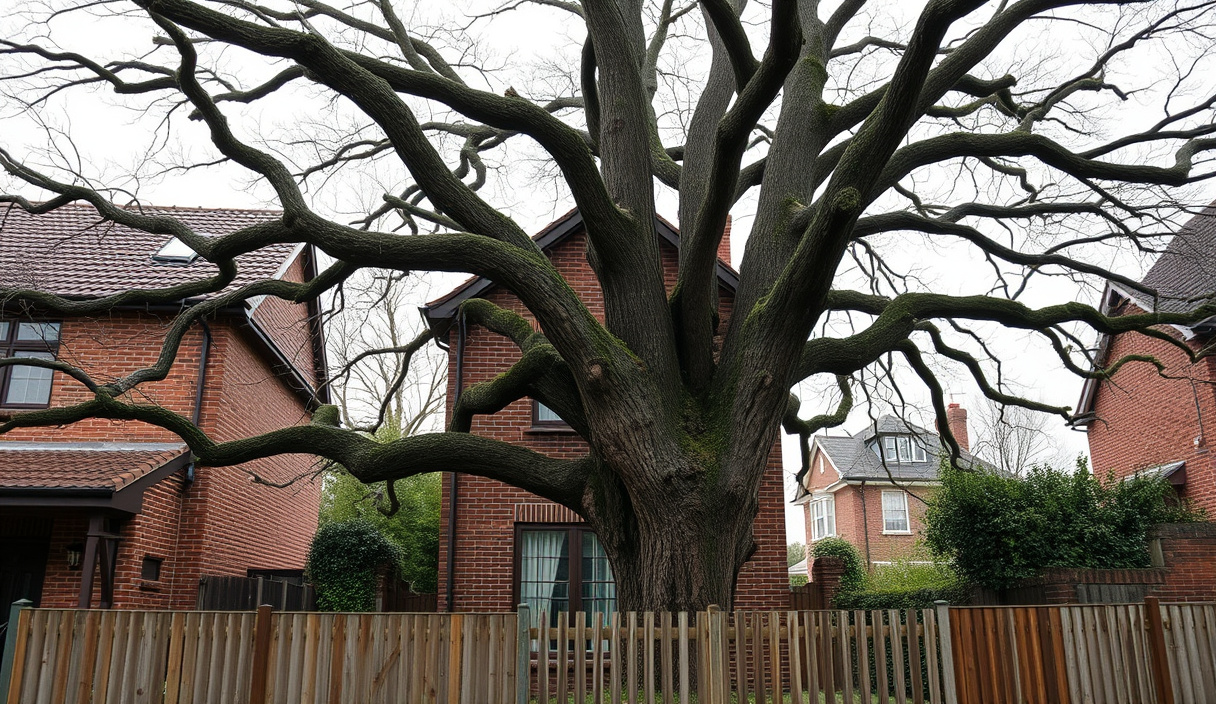
Tree removal is priced on risk and time, not on the tree. Two eighty-foot oaks can differ by a factor of four depending on what surrounds them.
The honest answer to “what does removal cost in Springfield” is that no one can tell you without a site visit, and any figure quoted sight-unseen is a guess that will be revised. What is worth understanding is which variables move the number, so you can read a quote and know whether it is reasonable.
| Factor | Why it moves the price |
|---|---|
| Access for equipment | A tree a crane or bucket truck can reach is dramatically cheaper than one in a fenced back garden requiring everything to be rigged out by hand |
| Proximity to structures | Open drop zones let a tree be felled in large sections; a tree over a roof, deck, fence or pool must be dismantled piece by piece and lowered on ropes |
| Trunk diameter | Diameter, not height, determines the weight of each section and the equipment needed to handle it |
| Tree condition | A dead or decayed tree cannot be climbed safely and cannot be trusted to hold rigging, which usually forces a crane or lift |
| Utility lines | Any conductor in the work zone adds coordination, and in some cases requires the utility to de-energise or disconnect before work begins |
| Debris volume and haul | Chipping on site is cheaper than hauling; a large hardwood produces far more material than people expect |
| Stump treatment | Grinding is a separate operation with separate equipment, and grinding depth changes the price |
| Slope and ground condition | Wet clay on a grade limits what equipment can be brought in without damaging the lawn or bogging the machine |
Two of those deserve emphasis because they are the ones homeowners consistently underestimate.
Access dominates everything. A crew that can put a bucket truck under the canopy will do in three hours what takes a climbing crew a full day. If your only route to the back garden is a metre-wide side gate, that constraint is the single biggest line item in your quote.
Dead trees cost more, not less. This is counterintuitive — the tree is smaller, lighter, has no leaves. But decay removes the structural integrity a climber depends on, and a rigging point that fails at height is a fatality. Standing dead wood usually means bringing in a crane or a lift, and the price reflects that. The practical consequence is that deferring removal of a dying tree does not save money. It costs money, and the increase compounds.
When removal is the right call, and when it is not
Removal is irreversible and a mature canopy tree is not replaceable within a human timeframe. A sixty-year-old oak represents sixty years of growth, shade, stormwater interception and property value. It is worth being sure.
Reasonable grounds for removal include:
- The tree is dead, or decline has progressed past the point of recovery
- Structural defects create an unacceptable failure risk over a target — a house, a driveway, a play area, a road
- Root or trunk decay has compromised the stem near the base, where failure is catastrophic rather than partial
- The tree is causing structural damage that cannot be resolved by other means
- Construction will sever a critical share of the root system, making decline inevitable
Grounds that usually do not justify removal, and where a second opinion is worth getting:
- Leaf litter, acorns, sap or shade
- A single dead limb in an otherwise sound canopy
- A lean that has been stable for years with no soil movement at the base
- A trunk cavity, which is common in old trees and not automatically dangerous
- Perceived risk after a storm elsewhere, without an actual assessment of this tree
The distinction that matters is between a defect and a hazard. A defect is a structural weakness. A hazard is a defect with something valuable underneath it. A hollow trunk in the middle of a woodlot is a wildlife feature; the same trunk over a child’s bedroom is a different proposition entirely. Risk assessment weighs the likelihood of failure against what the failure would land on.
Permission: what Fairfax County requires
For a homeowner removing a single tree from their own yard, Virginia law generally does not require a permit. The exceptions are narrow but real, and they are set out in the county’s guidance on tree removal and hazardous trees.
Land disturbance over 2,500 square feet. Clearing at that scale triggers approval requirements. The county’s Engineer of the Day (703-324-2268) confirms whether a given project crosses the threshold.
Resource Protection Areas. RPAs are the vegetated buffers protecting streams and wetlands, and within them the removal of trees or any vegetation is prohibited without a waiver. Accotink Creek and its tributaries run through the Springfield area, and properties backing onto those corridors are the ones most likely to be affected. Land Development Services (703-222-0801) handles RPA determinations.
Conservation easements recorded against the deed, which survive changes of ownership and are easy to forget about.
HOA covenants, which are private contracts entirely separate from county rules. A Springfield association can restrict removal on land the county would let you clear tomorrow.
Order of operations matters here. Confirm the RPA and easement position before scheduling work, because a crew cannot un-cut a tree, and a retroactive waiver application is a far worse conversation than a pre-emptive one.
Liability is the other half of the permission question, and it works differently than most people assume. Fairfax County has no authority to compel removal of a hazardous tree on private property unless it threatens the public at large — a neighbour’s tree menacing your garage is a civil matter between neighbours, not something the county will intervene in. The complete guide to tree care in Springfield covers that liability boundary and the documentation that protects you.
Power lines change the job entirely
If there is a conductor anywhere in the work zone, the job stops being ordinary tree work.
Dominion Energy serves the Springfield area, and its published clearance standard for distribution lines in unmaintained areas is a minimum of 20 feet above the primary line and 15 feet to the side. That is the utility’s own vegetation management, carried out on its schedule, not a service performed on request.
The division of responsibility is specific and frequently misunderstood:
- On distribution lines, Dominion performs the clearance trimming. Where it removes limbs in residential areas it clears the brush, but larger limbs and trunks stay on the property owner’s land, and the debris ultimately belongs to the owner.
- On service lines — the drop running from the pole to your house — Dominion trims only limbs vigorously rubbing the line. It does not remove live or dead trees from service lines. What it will do, at no cost, is disconnect the service line temporarily so the property owner or their contractor can work safely.
That disconnection offer is the single most useful fact in this section. A tree overhanging your service drop is your responsibility, but you do not have to work around a live conductor to deal with it — you arrange the disconnect first.
Virginia’s High Voltage Safety Act requires contacting the utility before working near lines. Untrained people should not be trimming near conductors under any circumstances; electricity does not require contact to kill, and arc flash across a gap has ended people who never touched a wire.
Planning the job
Work through this before you accept a quote:
- Confirm the tree needs to go. An assessment from a qualified arborist, in writing and dated, is worth having whether the answer is removal or retention.
- Check RPA, easement and HOA status. All three, not whichever seems most likely.
- Verify insurance. Ask for a current certificate of liability insurance and workers’ compensation coverage, and confirm it directly with the insurer rather than accepting a photocopy. An uninsured crew injured in your garden is your problem.
- Establish who is liable for property damage and what the process is if a fence, lawn or driveway is damaged during the work.
- Get the scope in writing. Whether the price includes stump grinding, how deep, whether grindings are removed or left, whether logs are hauled or stacked, and whether the site is raked.
- Identify underground utilities before any stump grinding. Virginia requires a locate request through VA811 before digging, and a stump grinder easily reaches the depth of shallow utilities.
- Agree access and protection. Which route equipment takes, what gets plywood over it, and where debris is staged.
- Ask about the drop zone plan. A crew that can explain how the tree comes apart, section by section, has thought about it. One that says “we’ll figure it out on the day” has not.
Stump, debris and what comes after
Removal leaves you with a stump, a volume of wood most people underestimate, and a gap in the canopy.
Stump grinding is a separate operation. Grinders reduce the stump and major surface roots to chips, typically to somewhere between 15 and 30 centimetres below grade depending on what you intend to do with the space — deeper if you plan to replant or lay turf, shallower if it is simply cosmetic. The stump is not extracted; the remaining root system decays in place over years. This matters if you intend to plant a replacement in the same spot, because decaying roots and a volume of wood chips make poor soil for a new tree.
Debris is usually chipped on site, with logs either hauled away, cut to firewood lengths and stacked, or left. Each is priced differently. Be aware that ash wood from an emerald ash borer area carries movement restrictions in some jurisdictions, and a reputable crew will know the current position.
Replanting deserves more thought than it usually gets. If the removed tree was within 20 feet of the house, that is the county’s own recommended minimum setback in marine clay areas, and replanting in the same footprint repeats the problem. Match the species to the space available at maturity rather than to the gap it looks like it fills today, and do not replant ash — Fairfax County discourages it and grants no canopy credit for it, because the borer is still present and still fatal.
Questions people ask
Do I need a permit to remove a tree in Fairfax County? For a single tree on your own residential property, usually not. You do need approval if the work disturbs more than 2,500 square feet, if the tree is in a Resource Protection Area, if a conservation easement applies, or if your HOA restricts removal. Check all four before scheduling.
How much does tree removal cost in Springfield? There is no honest single figure. Price is set by access, proximity to structures, trunk diameter, tree condition, utility lines, debris volume and stump treatment. Anyone quoting a price without seeing the tree is guessing. Get more than one quote, and make sure each is scoped identically — particularly on stump grinding and debris removal, which are the two line items most often quietly excluded.
Who is responsible if my neighbour’s tree falls on my house? Fairfax County will not compel a private owner to remove a hazardous tree unless it threatens the public at large, so this is a civil matter between neighbours. What generally changes the position is documented prior notice — a dated written assessment identifying the hazard, shared with the owner before failure, rather than after. Speak to your insurer about your specific policy, because coverage varies and none of this is legal advice.
Can I remove a tree myself? Small work you can reach from the ground with both feet planted, yes. Beyond that the answer is no, and the reasons are consistent: chainsaws bind and kick, sections weigh more than they look, ladders are not work platforms, and anything near a power line is lethal. Tree work has one of the highest fatality rates of any occupation, and the people who die doing it are usually not professionals.
Does the price include the stump? Often not. Stump grinding uses different equipment and is frequently quoted separately or as an add-on. Ask explicitly, and ask how deep, whether grindings are hauled away, and whether surface roots are included.
When is the cheapest time to have a tree removed? Dormant season, roughly late autumn through late winter, is generally easier work — no foliage, better visibility of structure, firmer ground for equipment, and less demand on crews. Emergency work has no season and is priced accordingly.
Who trims trees growing into power lines? Dominion Energy handles clearance on its distribution lines as part of its own vegetation management programme. Service lines running to your house are your responsibility, though Dominion will disconnect the line at no cost so the work can be done safely. Never attempt it while the line is live.
Sources: Fairfax County Public Works and Environmental Services and Land Development Services for permit thresholds, Resource Protection Area rules and hazardous tree responsibility; Dominion Energy for Virginia clearance standards and service line policy. Current as of September 2026. Regulations and utility policies change — confirm anything you are relying on with the county or the utility directly. Nothing here is legal or insurance advice.